What is the Massachusetts Opioid Settlement Funding Guide?
It is a free, practical guide for Massachusetts school districts and their town partners. It explains how opioid settlement funding works, which approved uses fit student mental health services, and how to build a need case, get internal buy-in, find a town partner, win approval, and report results. It also includes a fillable District Action Worksheet.
Can Massachusetts school districts use opioid settlement funds for student mental health services?
Yes, they can qualify, but the funds flow through your town, not directly to the district. Funds must support one of seven approved use categories under the State-Subdivision Agreement. Two fit school-based student mental health services: 3c (Connections to Care, which covers early identification and intervention) and 7e (Prevention, Education, Assessment, Planning, and Evaluation, which covers access to mental health services for young people). Each town decides which requests to fund.
How much opioid settlement money has Massachusetts received, and how is it distributed?
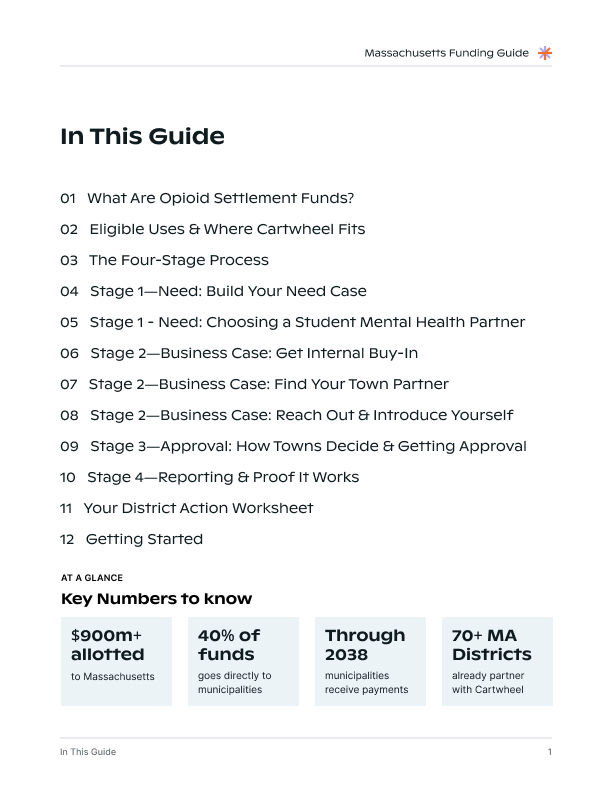
Massachusetts has received more than $900 million from nationwide settlements with opioid manufacturers and distributors. Under the State-Subdivision Agreement, 40% goes directly to cities and towns and 60% goes to the state's Opioid Recovery and Remediation Fund. Municipal payments follow a population-based formula, not a needs-based one, and continue annually through FY2038.
How can I find out how much opioid settlement money my town has received?
The Municipal Opioid Settlement Funding Expenditures Dashboard on Mass.gov shows what each Massachusetts municipality has received and reported. Mass.gov also publishes guidance for municipalities, and Mosaic's Municipal Training and Technical Assistance program accepts requests for help.
How do towns approve opioid settlement funding requests from school districts?
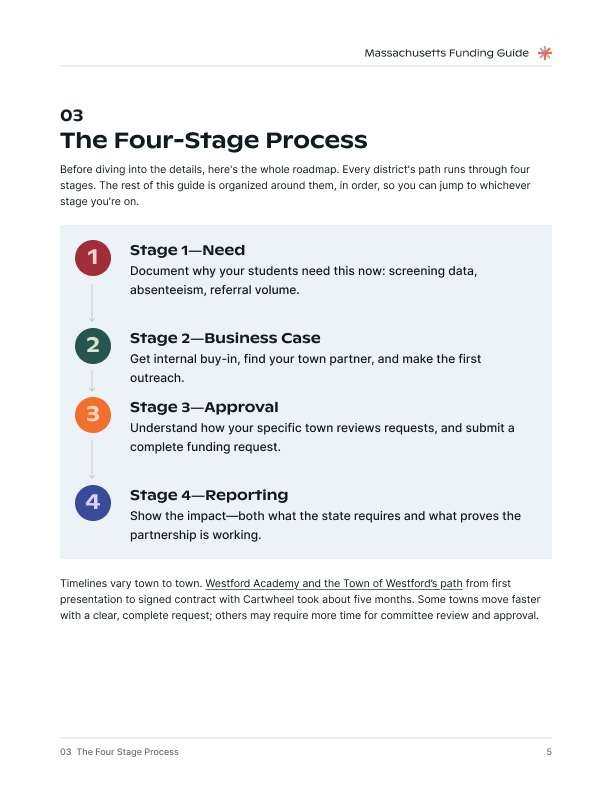
Every town has its own process. Towns must gather input from residents with lived experience before deciding how to spend settlement dollars, and approval often involves a town contact such as a Community Wellness Coordinator or Town Manager, plus the Select Board. In the examples in the guide, one town approved after a joint presentation, another started with a police department endorsement, and a third approved after a formal proposal. In Westford, about five months passed between the first presentation and a signed contract.
Has a Massachusetts school district used opioid settlement funds for student mental health care?
Yes. Westford Academy and the Town of Westford partnered with Cartwheel, funded in part through opioid settlement dollars. Over three years the partnership recorded 160 approved referrals, more than 1,800 therapy sessions, and a 54% reduction in student hospitalizations, and it is expanding from the high school to the middle school. Watch the webinar to understand more about their path to utilizing opioid settlement funds for student mental health services.
What data should a district bring to make the case for funding?
Reviewers want specific local numbers, not general statements. Strong requests pair need indicators (clinical screening scores such as PHQ-9 and GAD-7, referral volume, chronic absenteeism trends, substance use referrals, and hospitalization trends) with access indicators (waitlist length, distance to the nearest clinic, insurance eligibility, and language access at local clinics). The guide points to Massachusetts-specific data sources.
What reporting is required once a town funds a program?
As of August 2025, every Massachusetts municipality that receives settlement funds must file an annual expenditure report, regardless of the amount. Previously only towns receiving $35,000 or more per year had to file. The town files the report, but district program data, such as referral and engagement metrics, clinical outcomes, and attendance, behavior, and academic trends, makes it stronger.