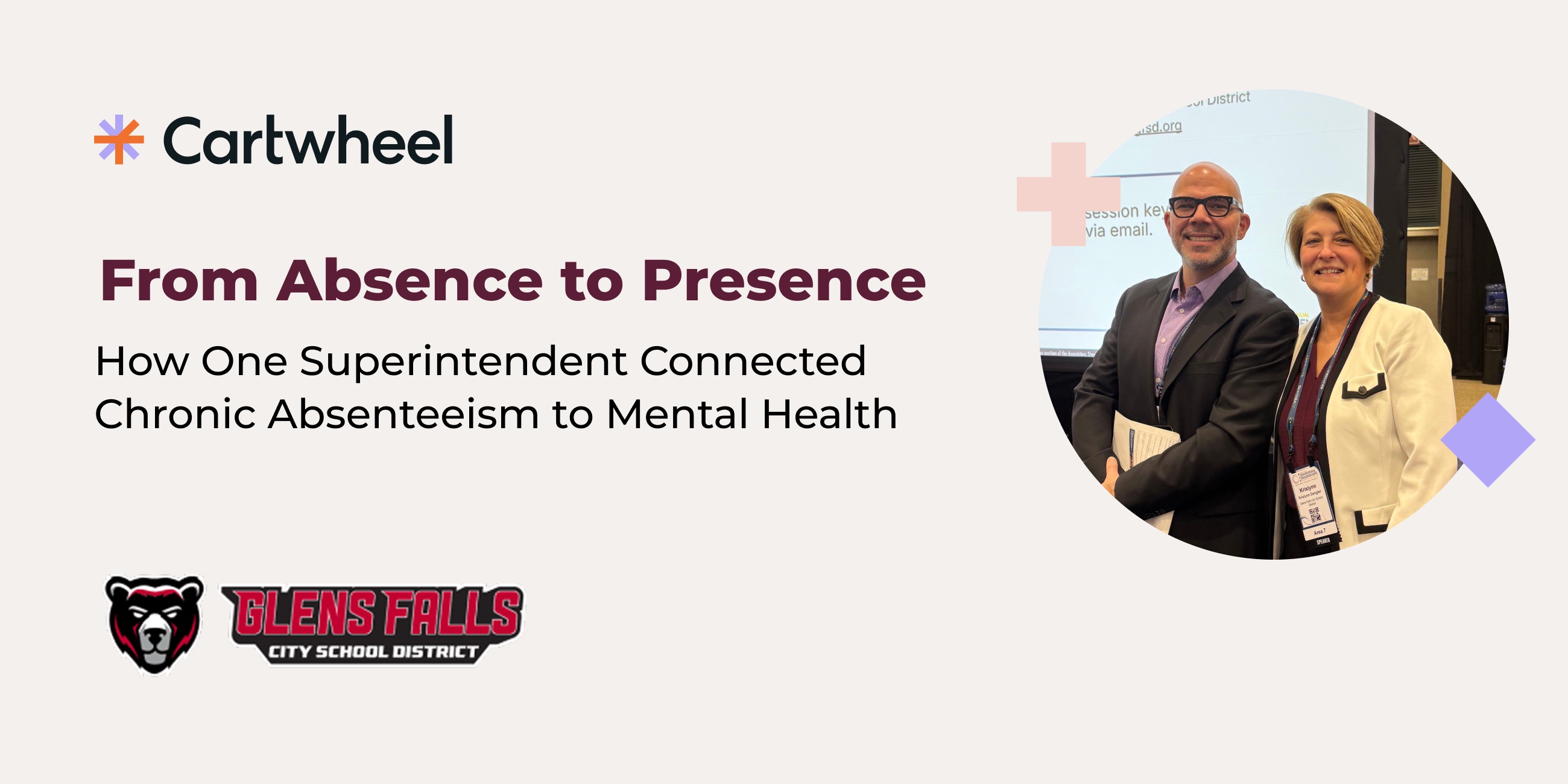
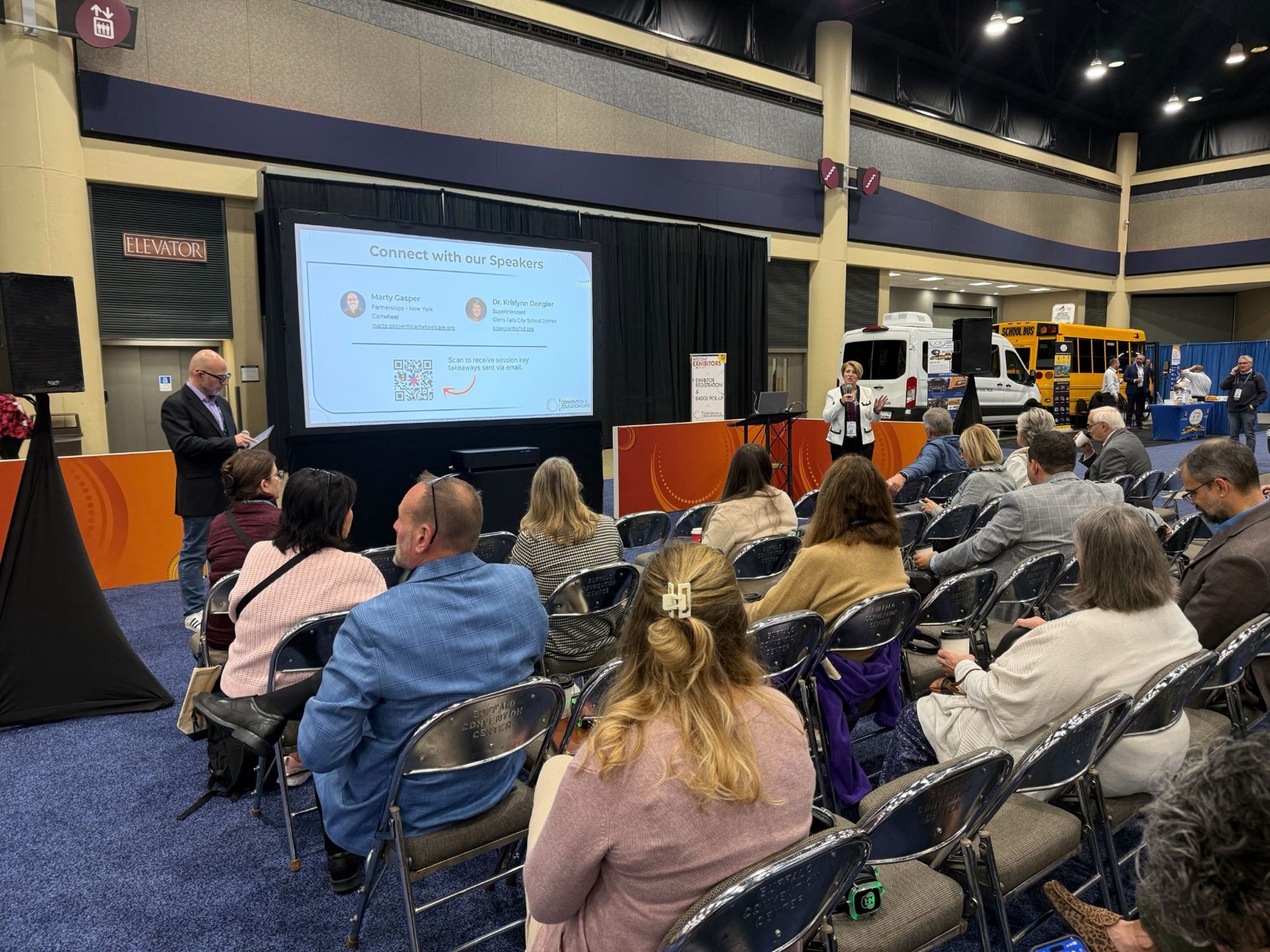
At the 2026 New York State School Boards Association (NYSSBA) Annual Convention in Buffalo, Dr. Krislynn Dengler, Superintendent of Glens Falls City School District, joined Marty Gasper, Partnerships, New York at Cartwheel, for a discussion with board members and superintendents from across New York State. Dr. Dengler is in her fifth year as superintendent of Glens Falls City, where her reading specialist background shapes how she approaches the district's attendance data.
When she arrived in 2022, about 1 in 3 students were chronically absent. By December 2023, the district had brought that rate down to 21%, from a COVID-era high of 34%. Dr. Dengler also shared that the middle school has moved from 34% to 19%. This recap covers the decisions behind those numbers and what school board members and district administrators can take from them.
Chronic absenteeism in Glens Falls City: why the district began treating absence as a signal
When Dr. Dengler became superintendent of Glens Falls City, her board had one clear charge: improve the graduation rate. By her account, it was about 70% at the time, in a district of roughly 2,000 students.
Rather than guess at the reasons, she went straight to the students who had left, calling former students from recent cohorts to ask why. What she heard was anxiety, frustration, depression, and family challenges.
She also saw that the longer a student is absent, the harder it becomes to return. From those conversations, Glens Falls City began reading absence as a signal of what students need, not as a compliance issue.
The district's earlier response relied on letters and home calls that felt punitive to parents, Dr. Dengler said. Kristy Moore, MTSS Director for Glens Falls City, described the shift: "Now it's more about stepping back and looking at what kind of support does that child need." When 26% of students were chronically absent in August 2023, she told the board, "You have to look at attendance as a symptom."
What the district built: a dedicated MTSS Director, building-level teams, and community partners
The board supported creating a Director of Multi-Tiered Systems of Support (MTSS) with a sole focus on chronic absenteeism. Building-level chronic absence teams and individualized re-entry plans followed, and the district hosted a Community Call to Action that brought together about 20 regional organizations. The position and related mental health services appear in the district's approved operational budget, which includes student mental health support for both in person at school and through telehealth.
School-based telehealth for New York students: how Cartwheel supports counselors and social workers
Glens Falls City has social workers, school psychologists, and school counselors in its buildings, but Dr. Dengler said the need was greater than the team could meet on its own. Cartwheel adds capacity alongside those counselors and social workers by providing clinical care to students they refer, while school staff remain the first point of contact.
School staff can view their Cartwheel dashboard which shows which students are being served and where each one is in the process, so the team can track a student's progression through care. Dr. Dengler said the goal is for students to graduate out of care once they have what they need, since the district does not want lifelong need. Staff have remained in place with Cartwheel providing additional capacity: "We have not cut a position or anything like that," she said.
Glens Falls is a small city where many families do not drive, so care delivered at home removes a transportation barrier. Dr. Dengler also valued the family support Cartwheel offers, which gives educators an opportunity to engage with families on needs that schools have not always been able to influence.
Cartwheel's family webinar series and on-demand recordings give parents tools they can use right away. Dr. Dengler shared a recent message from a parent who used content from the friend drama webinar to help her child, and noted that families have responded positively because the intake process is easy. Her team can also support parents who need help completing forms. Families can share their interest in care through the family interest form, and staff can refer students through the staff referral portal.
Dr. Dengler shared the story of an eighth grader who was frequently suspended, returned from long absences with anxiety, and whose family could not access therapy through insurance. In high school, the MTSS Director connected him to a no-cost seat funded by the district. He now attends every day on a modified schedule, and "without Cartwheel, he would not be where he is," Dr. Dengler said.
Dr. Dengler's MTSS Director describes Cartwheel as “the best partner they have worked with,” citing its attentiveness, quick onboarding of students, and communication. Some districts may wonder whether care delivered through telehealth can match the in-person care they already know. Dr. Dengler noted that even with Cartwheel’s care being delivered virtually, the partnership has been as strong as her partnerships with some in-person providers who work in her buildings.
How district administrators and school boards fund and sustain student mental health services in New York
The work was built to last from the start. Dr. Dengler said it fit a goal already in the district’s strategic plan around opportunity and support, and the board went on to create the MTSS Director role. That director now reports to the board regularly on return on investment, and the middle school recently co-presented its attendance gains at a board meeting.
Dr. Dengler described three pieces to funding. Services purchased through Cartwheel are BOCES-aidable, and she cited an aid rate of about 67% for Glens Falls City. The reimbursement rate is different throughout New York: some rural or high-need districts may see individual reimbursement rates around 47% or higher, while wealthier districts receive a lower percentage. Cartwheel bills insurance directly for families with coverage, including Medicaid, and the district provides a number of no-cost sessions for students without insurance or who are underinsured.
Dr. Dengler emphasized that the goal is to build systems that last beyond any one person, so the work continues when leaders change. Staff have responded positively to the partnership and feel supported by it.
Where to start: a first step for school board members and superintendents
Dr. Dengler suggested the first place for school board members and superintendents to look is data. Start by deciding what the district is trying to tackle first, then look for what is driving it. Chronic absenteeism, truancy, and tardiness can look similar on the surface but stem from very different needs, such as anxiety, transportation, or family challenges, and a climate survey of staff and students can help clarify which one a district is facing.
Districts across New York are building stronger partnerships with families and community partners, and Glens Falls City's experience offers a path other districts can adopt. A few practical starting points emerge: review attendance alongside graduation and suspension data, take stock of existing counselor capacity, and ask which outcomes would make a student support model worth sustaining. Cartwheel welcomes the chance to help school board members, superintendents, and district administrators explore whether a partnership like this fits their district.

FAQs: What District Leaders and School Board Members Should Know
How does a New York school district pay for Cartwheel services?
Dr. Dengler described three pieces to funding student mental health support. Services purchased through Cartwheel are BOCES-aidable, so Glens Falls City receives BOCES aid on the service. Cartwheel bills insurance directly for families with coverage. The district also purchases a set number of no-cost seats for students who do not have insurance or cannot use it. Dr. Dengler said the board continues to fund Cartwheel services as an operational budget line item, because the work is part of the district's strategic plan on chronic absenteeism and the district reports on those strategic initiatives to the board.
Will school counselors and social workers feel replaced by a telehealth partner?
At Glens Falls City, Dr. Dengler said, the answer has been no. Staff stay in the lead: they refer students, remain the first point of contact, and can follow each student’s progress through the dashboard. Cartwheel adds capacity alongside them, and Dr. Dengler said her team has been positive about the partnership and feels supported by it.
How long did it take to see chronic absenteeism improve after a New York school district began partnering with Cartwheel?
Glens Falls City School District's progress built over several years. Chronic absenteeism fell from 34% at the 2021 peak to 21% by December 2023, as the district built its MTSS structure and building-level teams. Cartwheel joined in the 2024-25 school year, and by that fall, every building was continuing to decrease chronic absenteeism, according to the district's MTSS Director. Dr. Dengler shared that the middle school is now at 19% in 2026-2027 school year, down from 34%.
About the Speakers
Dr. Krislynn Dengler, Superintendent, Glens Falls City School District
Marty Gasper, New York Partnerships, Cartwheel