
When a student struggles with reading or math, districts respond with rigorous, data-driven systems to provide the right intervention. When anxiety or depression shows up as missed days, behavior concerns, or falling grades, the response is too often reactive rather than systematic, even though mental health affects the outcomes districts are held accountable for: chronic absenteeism, graduation rates, and suspensions. Student mental health deserves the same rigor.
That was the premise of a session at the Massachusetts Association of School Committees (MASC) and Massachusetts Association of School Superintendents (M.A.S.S.) Joint Conference in Danvers, Massachusetts, on November 4, 2026. Dr. Jason DeFalco, Superintendent of Marlborough Public Schools in Massachusetts, and Dr. Adrian Talley, Superintendent of Stamford Public Schools in Connecticut, shared how they are putting that idea into practice. Dr. Talley joined Stamford Public Schools in 2026 after leading Indian Prairie School District 204 in Illinois. Jillian Kelton, M.Ed., Senior Director of District Engagement at Cartwheel and former Chief of Student Support at Boston Public Schools, moderated the conversation with superintendents, district administrators, and school committee members. This recap covers how the panelists approach early warning data, funding, and the partnership between school committees and superintendents.
Without accountability measures for student mental health, unmet needs show up as academic, behavior, and attendance struggles
The session illustrated the gap with two eighth graders. When Sarah’s reading grades drop, her school responds with a planned process: a conversation with her family, tiered interventions, and documentation through a multi-tiered system of support (MTSS). When Marcus’s anxiety shows up as late arrivals, early departures, and then missed days, his needs often go unnoticed until a chronic absenteeism letter goes home. If he is referred to a community counselor, there is often no way for that counselor to share progress with the school team, so the school cannot adjust its own support.
The difference comes down to accountability. Schools are measured on academic outcomes, and no comparable measure exists for student mental health, even though unmet needs can be the root cause behind academic, behavior, and attendance struggles. Dr. Talley, reflecting on his time leading Indian Prairie School District 204 in Illinois, noted that the report cards for his schools there did not include a measure of student well-being. “If children are not well socially and emotionally, there’s no way they’re going to be well academically,” he said. Students in that district asked leaders to change a strategic plan goal from student achievement to student development, a question he invited committees to ask of their own plans. Anxiety and depression are the leading cause of chronic absenteeism, Jillian added, so students cannot fully engage in learning until that root cause is addressed.


Marlborough Public Schools is aligning the student support roles it already has into a coordinated system
Marlborough Public Schools serves about 4,400 students, about 60% of whom speak a first language other than English. Dr. DeFalco described a school committee that already discusses academics, attendance, discipline, bullying, and mental health screeners at its meetings, and a district that had prioritized roles such as wraparound coordinators in every school, adjustment counselors, a re-engagement coach for attendance, and a social emotional learning specialist. What was missing was structure. “We’re resource rich but systems poor,” he said. The district tracked indicators such as attendance, bullying reports, and discipline data, but needed a way to see what was moving the needle.
Through budget workshops and a new strategic plan, the school committee supported realigning positions and restructuring the Office of Student Services, including a new executive director of clinical services, to bring support closer to schools. Each school now has a board certified behavior analyst and a social emotional learning interventionist, and the district has opened a therapeutic day school, all within a budget increase of about 2.5%. “Different doesn’t necessarily mean more,” Dr. DeFalco said.
Dr. DeFalco emphasized that alignment takes time. As new roles take shape, staff are building shared routines, and he keeps the school committee updated on progress and next steps. Early on, he approached questions about what was working as a shared look at the data, which helped teams see the review as a way to understand impact together.
Early warning systems start with data districts already have and a regular team meeting to review it
Attendees were polled on where their district currently sits on building mental health support. More than half, 54%, said they have counseling or mental health services that are not connected to attendance, behavior, or academic data, while 29% have a district-wide system and track whether it is working.

Districts starting this work can begin with data they already have. “In Boston, the data was never the problem,” Jillian said. Attendance, suspension, nurse visits, and behavior referral data existed, but there was no way to read it together. In Marlborough, the first step was bringing adults together to review the data regularly, deciding what to look at and how often, and drawing on the state’s list of students in the bottom 25% academically alongside tools that make the data easier for school leaders, the school committee, and the community to understand.
Early warning systems work best when each flag leads to a clear next step. Districts need to know who responds when a student is flagged and how to match the right support to that student, since students may prefer to meet with a counselor in school, outside school, virtually, or in a group. Teachers play a role as “noticers” who can alert a counselor when something changes, without taking on more work. Families are partners in this too, and districts can create more positive access points beyond calls that carry difficult news.
Districts can fund and sustain student mental health programs through grants, opioid settlement funds, and small annual budget lines
Districts building student mental health programs with a limited number of school counselors, psychologists, and social workers can look to community partners for added capacity. At Indian Prairie School District 204, a local hospital foundation awarded a $500,000 grant that funded eight free after-school therapy sessions for students and families, who could be nominated by staff or nominate themselves. Dr. Talley encouraged districts to explore local hospitals and the district’s health care provider, since contracts may include funding, and noted that a skilled grant writer can frame opioid funding to support therapy for students.
In Massachusetts, Cartwheel is working with districts on opioid settlement funds, and Westford Public Schools offers a model. The district and the town’s Community Wellness office partnered to direct settlement funds toward school-based mental health support at Westford Academy. Districts can watch the Westford webinar to hear how the partnership came together and use the opioid settlement funding guide to see what funding may be available in their community.
District leaders recognize that grant funding is not a long-term route, so sustaining a program means eventually funding it in the operational budget. Dr. Talley encouraged districts to begin with whatever they can commit: “50,000 is better than zero,” he said, and even 25,000 is better than nothing. Starting small can also mean piloting a program or making a modest investment, such as Mental Health First Aid training for staff, while building out the referral process so every referral leads to ongoing support.
School committees and superintendents sustain student mental health work through shared data and clear goals
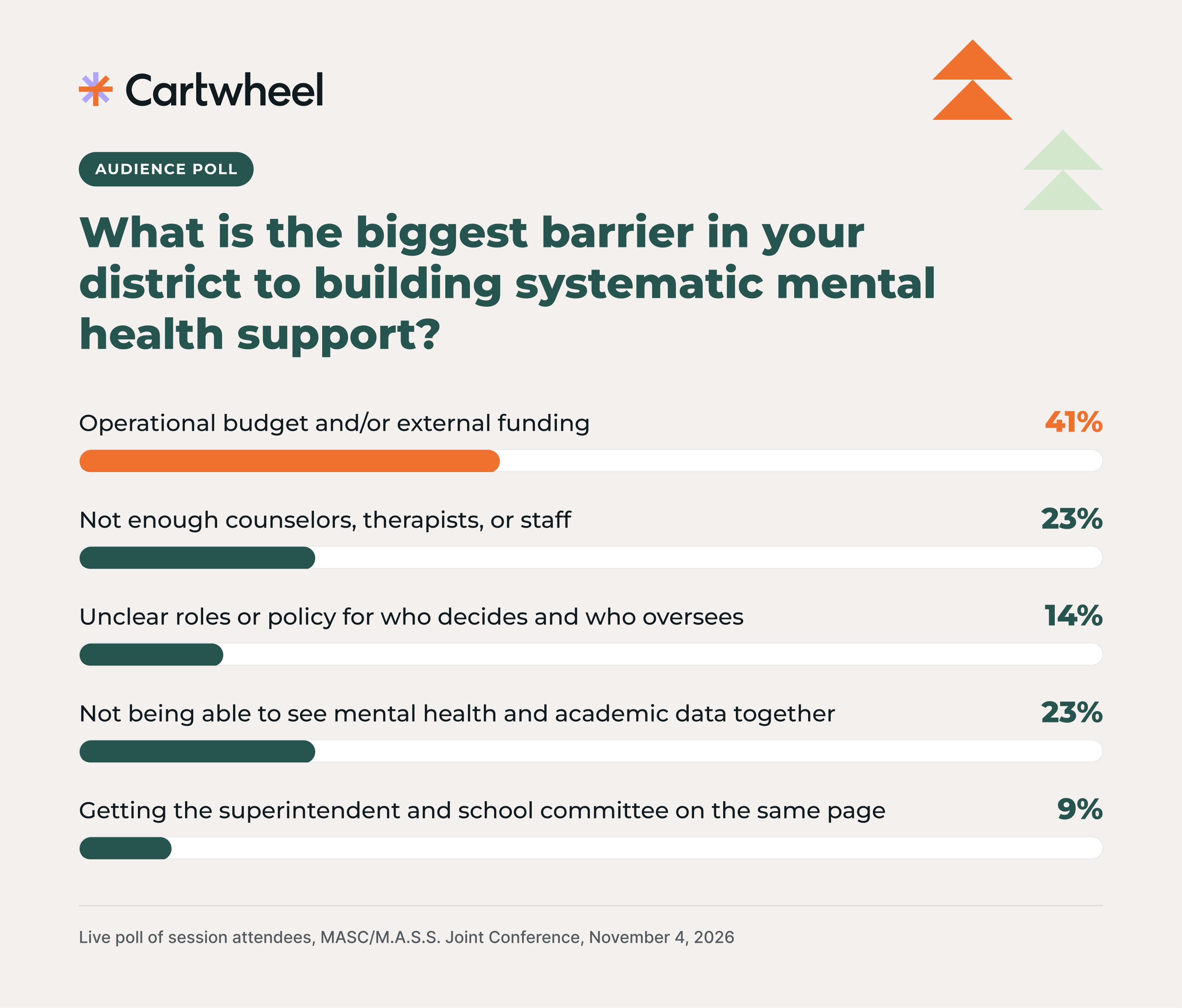
When asked about the biggest barrier to building systematic mental health support, attendees chose operational budget and/or external funding most often (41%), followed by not enough counselors, therapists, or staff and not being able to see mental health and academic data together (23% each).
Barriers like funding and data visibility are easier to address when superintendents and school committees work from the same information. Dr. DeFalco described what superintendents bring to that partnership: a clear plan with goals and indicators and honest reporting on what is and is not working, supported by policy and budget decisions that keep the work aligned. Dr. Talley advised districts to “make it matter to your board” by showing return on investment, quarterly in some cases. Jillian noted that chronic absenteeism, graduation, and suspension rates already appear on DESE report cards, and that improving them depends on listening to what students and families tell us. Progress also takes patience. If a district adopts a math curriculum that is not working, it adjusts rather than stopping math instruction, and mental health supports deserve the same approach.
A few practical starting points emerge from the conversation: read attendance, behavior, and academic data together, align the roles a district already has, look beyond the operating budget for funding, and keep the school committee informed with indicators it can follow. “If it feels overwhelming, it’s because it is, and it’s okay,” Dr. DeFalco said. Jillian closed the session with a look ahead: chronic absenteeism and graduation gaps are solvable, and the data and framework exist. What remains is bringing the same rigor to mental health that we bring to academics.
As we continue these conversations with district and school committee leaders across Massachusetts and beyond, we invite districts to learn how Cartwheel’s care programs can work alongside the counselors, social workers, and school psychologists already in place.

Audience Questions: What School Committee and District Leaders Wanted to Know
How can a school committee member start the conversation without overstepping administrative responsibilities?
Dr. Talley suggested starting with questions rather than directives. A few starting points:
- What happens before a concerning behavior or an absence, and what might be behind it?
- What are we doing to address anxiety and the reasons students are not coming to school?
- Do the staff in our buildings need more support right now?
To understand staffing needs, he recommended comparing the district’s current numbers to recommended ratios: about 250 students per school counselor and about 500 students per school psychologist. Most districts will not reach those ratios, but knowing where the district stands helps show how much additional support may be needed.
How does school-based telehealth work with insurance and existing providers?
Jillian explained that Cartwheel’s services are delivered through telehealth, and that districts using them also engage providers who deliver care in person. Cartwheel partners with Marlborough Public Schools in this way. She shared that Cartwheel bills insurance, including MassHealth, and that pro bono funds are available for students who are uninsured or whose co-pays are too high. Telehealth works alongside school counselors, social workers, and other school-based providers rather than replacing them.
How can school committees support the superintendent with student well-being in other agenda priorities?
School committees contribute most through accountability: setting direction, approving budgets, and making sure the district measures what is driving student outcomes. The panelists pointed to a few ways to do that.
- Ask for data that points to root causes. Jillian encouraged committees to look at attendance, behavior, and academic indicators together, alongside the chronic absenteeism, graduation, and suspension rates already on DESE report cards, since mental health needs often show up there first.
- Look for a feedback loop and a range of services. Committees can ask whether the district can see how students are responding to support, and whether it offers different types of services, such as in-school, virtual, group, and community-based options, to match different student needs.
- Set policy and budget alongside the superintendent. Dr. DeFalco described a clear plan with goals and indicators, honest reporting on what is and is not working, and a policy subcommittee that keeps policies aligned with the work.
- Make it part of how success is measured. Dr. Talley shared that his annual evaluation included the number of students receiving therapy and survey feedback, and he advised districts to “make it matter to your board” by showing return on investment, quarterly in some cases.
About the Speakers
Dr. Jason DeFalco, Superintendent, Marlborough Public Schools (Massachusetts)
Dr. Adrian Talley, Superintendent, Stamford Public Schools (Connecticut)
Jillian Kelton, M.Ed., Senior Director of District Engagement, Cartwheel