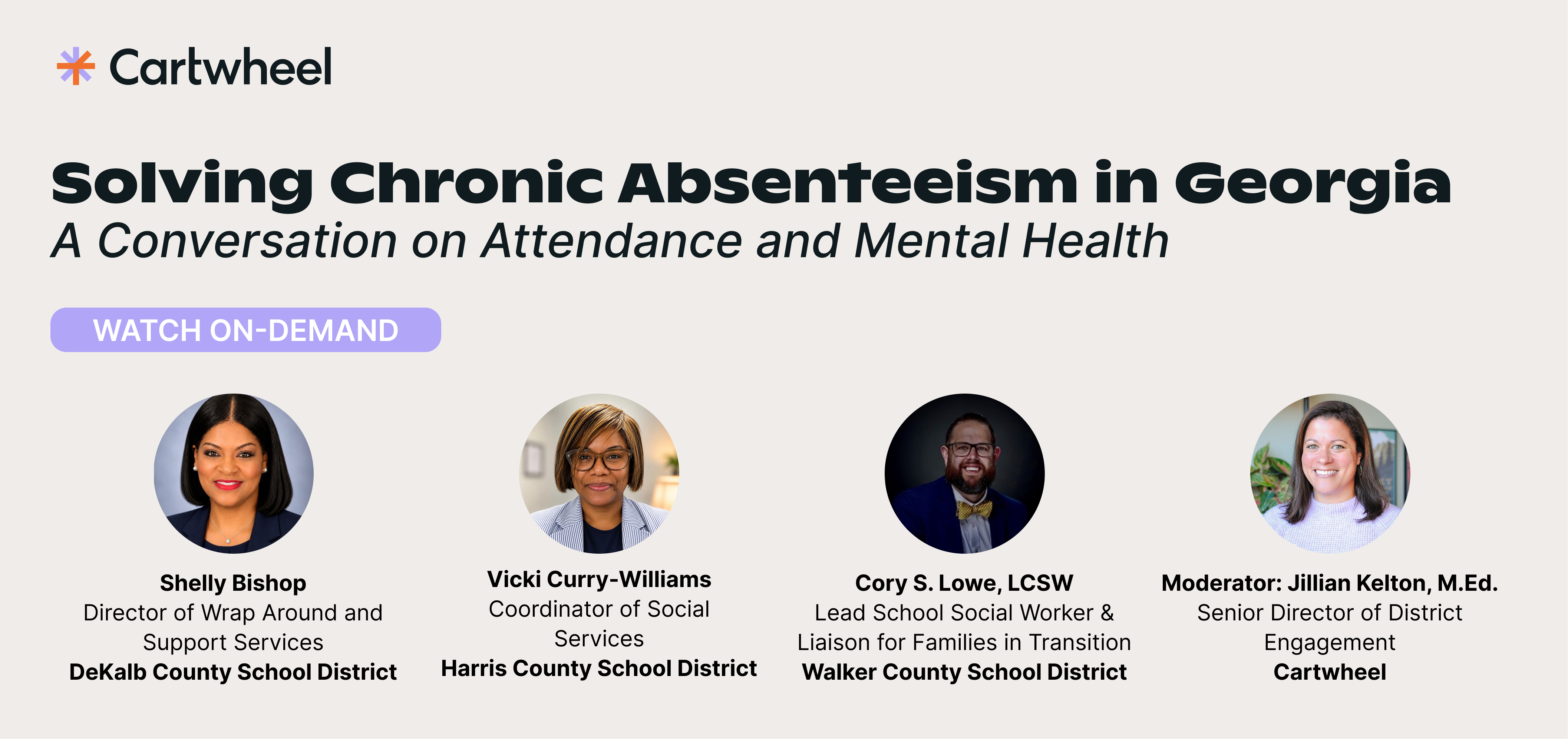
Georgia has made steady progress on attendance. The state's chronic absenteeism rate fell to 17.7% in 2025-26, down from 19.5% in 2024-25 and from a peak of 23.9% in 2021-22, continuing a five-year trend of improvement. That progress is happening as Senate Bill 123 reshapes how districts respond to students who miss school. On October 7, 2026, Cartwheel hosted Solving Chronic Absenteeism in Georgia: A Conversation on Attendance and Mental Health to hear how districts are putting the law into practice this year.
Jillian Kelton, M.Ed., Senior Director of District Engagement at Cartwheel, moderated a conversation with Shelly Bishop, Director of Wrap Around and Support Services at DeKalb County School District; Vicki Curry-Williams, Coordinator of Social Services at The H.O.P.E. Center for Harris County School District; and Cory S. Lowe, LCSW, Lead School Social Worker and Liaison for Families in Transition at Walker County School District and Past President of the School Social Workers Association of Georgia (SSWAG).
Asked to sum up their school year so far in one word, the panelists chose “crisis”, “intentional”, and “collaborative”. Those three words set the tone for the conversation.
SB 123 and student attendance: what changed in 2026
Senate Bill 123 took effect on July 1, 2025. The 2026-27 school year is when its requirements show up in day-to-day practice and in public data:
- Chronic absenteeism definition. A student who misses 10% or more of school days is considered chronically absent.
- Written attendance protocols. Each county's student attendance and school climate committee was required to adopt a written student attendance protocol, and districts to implement it, by June 1, 2026. The protocol covers how to identify, report, and address attendance issues.
- Attendance review teams. School systems with a chronic absenteeism rate of 10% or higher, and individual schools at 15% or higher, must establish attendance review teams that develop intervention plans for chronically absent students.
- No expulsion for absences alone. Students can no longer be expelled solely because of absences.
- A stronger Attendance Dashboard. GaDOE's public Attendance Dashboard now lets districts monitor progress toward SB 123 requirements, including for school and district attendance review teams, and track students who miss 20%, 30%, or more of enrolled days, not only the 10% threshold.
- State reporting. Starting in 2026, GaDOE reports to legislative committees of the Georgia General Assembly on county-level compliance, attendance rates, and discipline data.
These protocols, review teams, dashboard, and state reporting put attendance work in public view at the county level.
SB 123 and student mental health are connected through the root causes of absence. Intervention plans work best when they address why a student is missing school, and the reasons vary. For one student it may be anxiety or depression. For another it may be a transportation need, unstable housing, a chronic health condition, a family crisis, or a language or cultural barrier. Attendance review teams look at the full picture, and when a mental health need is part of it, access to care becomes one of the supports in the plan.
Georgia's state student mental health grant gives districts a funding source for that support. The FY26 state budget (HB 68) provides $20,000 for each public middle and high school, and GaDOE has confirmed that the $20.7 million appropriation continues for FY27. The GaDOE grant guidance outlines allowable uses and reporting requirements. Districts can use the funds to contract with a local mental health agency, a telehealth provider, or an individual mental health professional, hire a mental health professional, or purchase curriculum and intervention materials, as GaDOE has described.
Two Cartwheel resources can help districts plan. The HB 68 Funding Guide explains how the grant works, and our earlier conversation with Representative Matt Dubnik, Chairman of the K-12 Education Appropriations Committee, covers the intent behind the funding. Cartwheel is also an approved vendor under GaDOE's request for student mental telehealth services, so districts can select Cartwheel when using their per-school grants.
Chronic absenteeism in Georgia: how districts are finding the root cause
Harris County School District: asking what is making it difficult to get to school
Harris County School District serves around 5,600 students near Columbus and Pine Mountain in west-central Georgia. Vicki described how the district used SB 123 to bring its existing attendance work together more intentionally. Harris County's review team now meets monthly, from the district office through each school, with teachers, principals, and assistant principals looking at the data together. The data shows who is missing school. The team's next job is understanding why.
Harris County moved from asking why a student is not coming to school to asking what is making it difficult for that student to get there. Getting families to join the conversation is key, and Vicki shared that parents are more likely to do this when they see the school advocating alongside them. The district organizes its work around four steps: identify, understand, support, and follow up. Early outreach is part of the routine, with families contacted after a student's first few absences, and summer letters welcoming back all students and setting attendance expectations.
Because of the intentional approach of Harris County, the district is seeing early results, with a student attendance rate reaching 97% in August and September.
Once the team identifies the root cause, and if that root cause is a student needing additional support, the H.O.P.E. Center (Helping Our People Excel) steps in. The center is overseen by the district's Department of Social Services and serves as a hub for wraparound services, including a food and clothing pantry, mental health services, educational opportunities for parents and students, and a confidential space for counseling. Vicki described the center as a barrier breaker. Staff connect families with community partners for economic assistance, medical care, and other needs, so help is available quickly when a student or school needs it. As a rural community with limited local resources, Harris County relies on those relationships to reach families.
DeKalb County School District: building attendance supports on top of what was already in place
DeKalb County School District is Georgia's third largest school system, serving over 92,000 students across 138 schools and centers. Shelly explained that prior to the 2026-27 school year, DeKalb County already had attendance protocols and school-based attendance teams in place. With the new SB 123 requirements, DeKalb County decided to add seven attendance specialists, funded through Title IV, and strengthened its data systems, including internal dashboards and real-time attendance information. The district also aligns attendance work with its MTSS, Check and Connect, and PBIS teams.
Attendance is part of the DeKalb County School District 2024-2029 Strategic Plan, so Shelly's team shares attendance progress and interventions with district leaders every month.
Three R’s guide how DeKalb County puts that plan into practice. They come from the superintendent's Forward Together transition plan, which commits the district to work through Relationships, Receptiveness, and Responsiveness, and Shelly's teams apply them to attendance.
In practice, relationships mean building trust with parents and students. Receptiveness means listening to families, and this year DeKalb County is adding student attendance plans to understand the reason behind each student's absences, along with a two-way communication channel that lets families share concerns outside of school-based teams. Responsiveness means following up, including returning parent phone calls and documenting that follow-up.
DeKalb County also operates eight Safe Centers in its high schools, student and family engagement centers where students can access tutoring, mental health programming, and a social work liaison, including a calm space to decompress and return to class. At schools with higher chronic absenteeism rates, the district is piloting a 40-day plan process with community partners, including the DeKalb County Solicitor General's office, to understand why students are missing school. The Solicitor General also offers an Educational Neglect Program for families of chronically absent students whose absences have not reached the level of formal prosecution.
Walker County School District: moving from truancy teams to CARES teams across northwest Georgia
Cory brought both a Walker County and a statewide perspective as SSWAG Past President. He described a shift across Georgia from a punitive approach to attendance toward looking for root causes. Walker County School District renamed its attendance review process, once known as the Truancy Treatment Team, to CARES, which stands for Connection, Attendance, Readiness, Engagement, and Support. The goal is for families to leave meetings feeling connected to the school and community, understanding why attendance matters, and knowing support is available when students return.
Walker County also changed its attendance contracts to focus on barriers instead of a list of what a family must do, and interventions follow a tiered structure like MTSS. Just as important, Walker County looked at attendance across county lines. Students in northwest Georgia often move between neighboring districts, so Walker County rewrote its policy alongside social workers in neighboring districts, including Catoosa County, to use the same terminology and a similar process. A student who moves between districts in the area has a similar experience, and families hear a consistent message from the whole community.
Cory also shared that his district used state grant funds to add a dedicated mental health and crisis support professional for its middle and high schools, who works in small groups with students over the chronic absenteeism threshold. In his view, the role of the school social worker is shifting from being called in at the point of crisis to working proactively with students, families, and the whole school system.
Student mental health services in Georgia: how attendance and mental health care connect
What happens when the root cause of an absence is a mental health need? In Georgia, families often have few places to turn. According to the Rural Health Information Hub, 151 of the state's 159 counties face a shortage of mental health providers. Vicki described that reality in Harris County, where the area has no local mental health provider and the district has seen an increase in students with mental health concerns.
Harris County partners with Cartwheel, and the district shares information about Cartwheele for students in grades 6 through 12 with families. Vicki shared that the partnership gives the district another pathway to care that can be brought into the school day, with case management that helps bring parents into the conversation. She called it "so accessible" and said it is "not another disconnected program." She also spoke about normalizing care for students and families, noting "it's all right to receive care." From the start, she said, she expected the partnership to be a "game changer."
DeKalb County School District already had school-based mental health services prior to the student mental health grants, so the telehealth partnership with Cartwheel added a focused pathway for students in grades 6 through 12, an age group Shelly noted can be harder to support when some parents believe older students are grown. She described the result as "a clinical pathway for that specific age group," adding "we've leveled up." Shelly also noted that school avoidance was not a regular topic of conversation before the partnership, and that social workers, school psychologists, counselors, and mental health coordinators are now engaging with it more directly. One way staff are engaging is through the staff referral portal and sharing the family interest form with families to self identify when they notice a signal that their child needs additional support.y are Georgia districts turning to telehealth? Providers are scarce, transportation can keep families from getting to appointments, and language, cultural differences, and stigma can add further barriers. Many families and educators also feel strongly about in-person care, and that preference makes sense. That is why the districts on this panel use telehealth to support their existing counselors, social workers, and school-based providers, not to replace them. Cartwheel's Georgia-licensed clinicians offer sessions at school or at home, with evening and Saturday hours and care in multiple languages, so families can connect in the way that works for them.
School avoidance and chronic absenteeism: how the School Avoidance Program works
That is where Cartwheel's School Avoidance Program fits. It supports students who find it hard to attend school regularly, along with the families helping them. Care includes 1:1 therapy with clinicians trained in school avoidance, parent guidance sessions and optional skill-building groups, an assessment to understand the reasons behind avoidance, and psychiatric evaluation and medication management when appropriate. Because care is delivered by telehealth, students can connect with a clinician even when they are not in the building, and clinicians collaborate with school teams so attendance teams and MTSS teams can coordinate tiered supports and re-entry plans.
The School Avoidance Program is one of three Cartwheel Care Programs, alongside Screens & Social Media and Big Behaviors & Big Feelings. Here outcomes on absenteeism and behavior from other districts:
- Peoria Public Schools (IL): 62% reduction in absences per student, from an average of 16 days absent to 6, and a 68% reduction in suspensions for students with a prior disciplinary history, among students who received care between 2022-23 and 2024-25.
- Salem Public Schools (MA): 45% drop in chronic absenteeism among students receiving Cartwheel services.
What is next for student attendance and mental health in Georgia
Cory closed the conversation by looking ahead. He described SB 123 as a foundation for continued progress and encouraged leaders to use attendance review teams to go deeper than compliance by addressing the reasons students miss school.
Cory sees attendance and mental health concerns starting in earlier grades and carrying through a student's school years, so support has to start earlier too. The state grant serves middle and high schools, and he encouraged educators to talk with their legislators about extending support to elementary students, where early signs of anxiety and depression can appear. Building relationships with families when students are in kindergarten gives schools a chance to connect them with resources early and to treat attendance as a health support issue as well as a legal one. GaDOE reports a chronic absenteeism rate of 13.5% in grades K-5, which shows the early grades are part of the picture.
He also pointed to students beyond the ages covered by Georgia's compulsory attendance law. The same tiered supports can reach younger students and older students alike, including older students who may need evening or alternative programs. Cory shares specific examples in the audience questions below.
Educators who want to share what their schools need can start with the Georgia General Assembly's Find Your Legislator tool to identify their state representative and senator, and the Georgia.gov guide to contacting state legislators for tips on writing, calling, or emailing. Georgia lawmakers have also introduced proposals to expand school-linked behavioral health funding, including the School Behavioral Health Support Act (HB 24).
Georgia districts are building attendance teams, protocols, and supports at the same time the state is making results visible. Reaching students earlier and for longer means attendance strategy, funding, and access to care working together. We would welcome the chance to talk with your team about how Georgia's student mental health grant can be used with Cartwheel, and how our Care Programs, including the School Avoidance Program, fit alongside your attendance review team.