Rethinking Chronic Absenteeism: Why Mental Health Belongs at the Center of Your Attendance Strategy
Chronic absenteeism is no longer a peripheral problem—it’s a defining challenge for school systems across the country. Coming out of the pandemic, districts like Boston Public Schools saw chronic absenteeism rates soar as high as 42%. Behind those numbers are students who are anxious, overwhelmed, working, caregiving, disconnected from school, or simply struggling to cross the building threshold each morning.
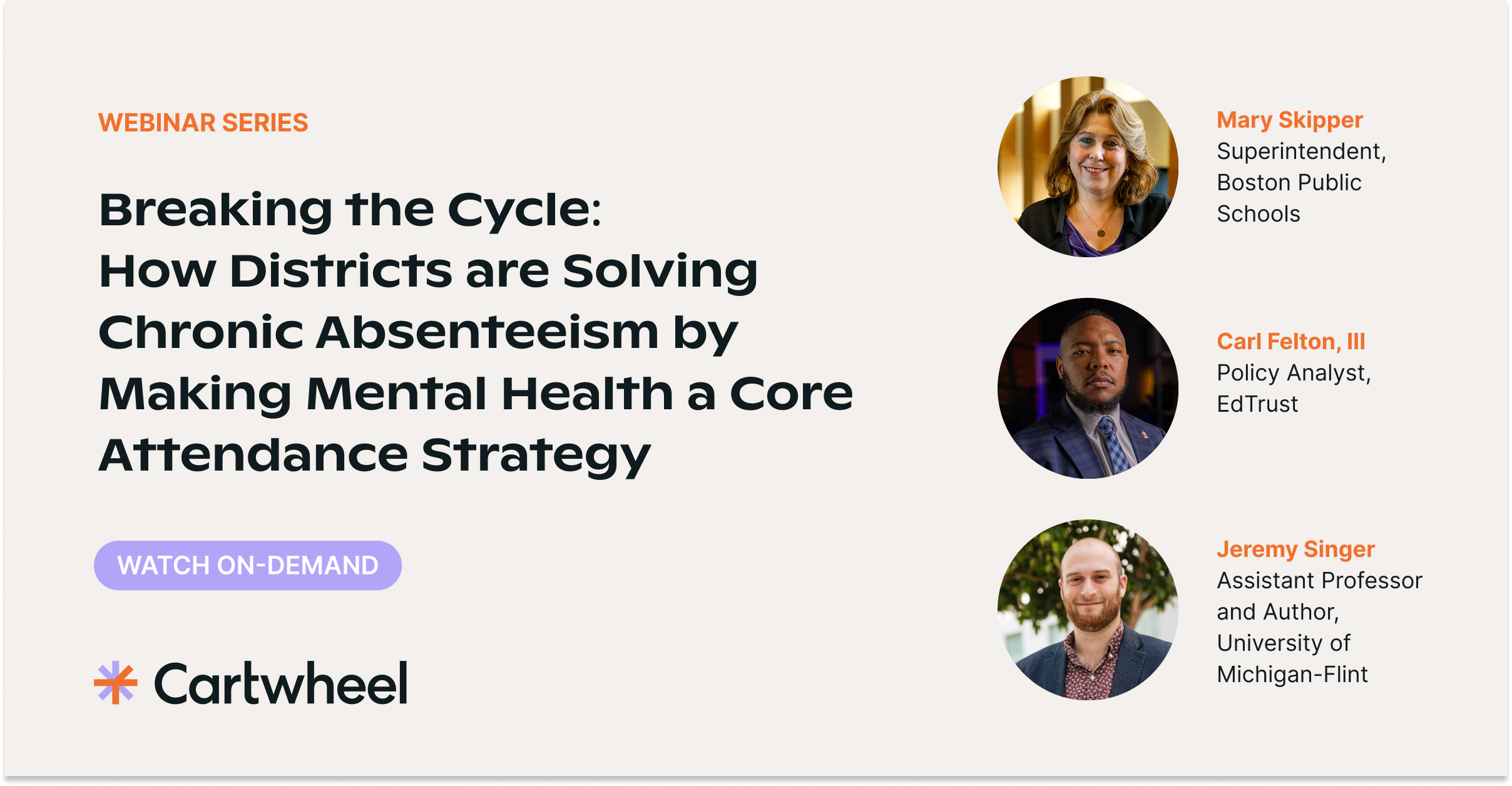
In our recent webinar, “Chronic Absenteeism & School Avoidance: Why Schools Can’t Solve It Alone,” we brought together three leaders who are tackling this challenge from different angles:
- Mary Skipper, Superintendent, Boston Public Schools
- Carl Felton III, Policy Analyst, The Education Trust
- Jeremy Singer, Professor, University of Michigan–Flint and co-author of Rethinking Chronic Absenteeism: Why Schools Can’t Solve It Alone
The conversation confirmed what many district leaders already feel: attendance is no longer just an “attendance office” issue. It’s a mental health issue, a systems issue, and an access issue—and it demands a fundamentally different approach.
Below are key takeaways for superintendents and district leaders, along with how Cartwheel’s new School Avoidance Program is designed to plug directly into this work.
Chronic Absenteeism Is a Symptom, Not the Root Problem
One of the clearest themes from the discussion: we’ve traditionally misdiagnosed chronic absenteeism.
In Boston, when Superintendent Skipper’s team dug into their data and talked directly with students and families, they surfaced a wide range of root causes:
- Rising anxiety, depression, and other mental health challenges
- Students acting as caregivers for siblings or ill family members
- High school students working substantial hours to support household income
- Safety concerns getting to and from school or within certain neighborhoods
- Students questioning the relevance of school, especially if they were already off track academically
- Fear among multilingual learners and immigrant families
At the same time, many people were still attributing absences to “laziness” or lack of motivation. Student surveys and direct conversations told a very different story—one centered on financial pressure, mental health, and disconnection.
The shift Boston made—and that our panelists strongly advocated for—is simple but profound:
Stop treating absenteeism as defiance. Start treating it as data about unmet needs.
The Access Lens: Who Is Most Impacted?
From a policy and research perspective, Carl Felton reminded us that chronic absenteeism disproportionately affects:
- Students of color
- Students from low-income backgrounds
- Students with disabilities
These patterns existed before the pandemic and have only been exacerbated since.
Many of the drivers sit outside school walls: housing instability, transportation gaps, family work schedules, neighborhood safety, and access to healthcare. Others are inside the school: bullying, low sense of belonging, unwelcoming school climates, and curriculum that doesn’t reflect students’ identities or lived experiences.
Effective strategies that states and districts are using include:
- Mental health interventions, like Cartwheel, to address the root causes of anxiety, depression, trauma, and more.
- Family engagement and home visits
- Community schools and wraparound services
- Transportation solutions in known “hotspots”
- Intentional school climate work focused on belonging and adult-student relationships
- Culturally sustaining curriculum and practices
The throughline: attendance improves when students and families feel seen, safe, and supported.
Moving Beyond Truancy: From Punitive to Supportive
Historically, attendance has been governed by truancy laws and accountability systems that emphasize compliance and punishment: letters, court referrals, and threats of legal consequences.
Our panelists argued that this approach is both ineffective and harmful—especially when mental health is a key driver.
Boston has deliberately moved away from a punitive approach toward one rooted in care, connection, and problem-solving, including:
- Reducing reliance on truancy court and legal action
- Launching a district-wide awareness campaign focused on the human impact of chronic absence (isolation, missed supports, lower achievement, dropout risk)
- Shifting messaging with families from, “Your child has missed X days,” to, “Here’s what we’re worried about for your child, and how we want to support them.”
Jeremy Singer emphasized that schools can’t and shouldn’t try to do everything alone. But they can:
- Create welcoming, inclusive climates
- Build strong relationships with students and families
- Partner with external providers to offer specialized clinical care
- Advocate for policy and funding that match the scale of student need
What Actually Works? Boston’s Multi-Tiered Approach
Boston’s progress—reducing chronic absenteeism by 7% in one year, with another 4–6% decrease projected—didn’t come from a single program. It came from a multi-tiered strategy:
Tier 1: Awareness and Culture
- District-wide messaging about why attendance matters for kids, not just for numbers
- Regular, relational communication with families via tools like ParentSquare
- Climate surveys to ensure every school feels safe, welcoming, and inclusive
- Celebrating small wins (e.g., a student returning for two days after a week of absence)
Tier 2: Early, Personalized Intervention
- Attendance mentors for students with emerging patterns of absence
- School counselors, social workers, and family liaisons actively engaging families
- Phone calls and home visits rooted in support, not blame
- Partnerships with after-school providers and coaches to help build supportive relationships and reinforce expectations.
Tier 3 (and beyond): Deep Wraparound Support
- Individualized student attendance plans that layer in mental health, academic, and family supports
- A Re-Engagement Center for students who have substantially disengaged
- Citywide “knock events,” with the superintendent, mayor, and volunteers visiting homes at the start of the year
- Credit recovery options for high school students who feel they have no path to graduation
- Peer-driven initiatives like “Tag a Friend” to encourage students to bring each other back
- Morning intramural sports and breakfast to hook middle schoolers into the day
- A student-designed “Win the Day” attendance campaign with meaningful incentives
- A “Tier 4” set of weekend events—food, activities, and programming for students and families facing instability, to keep them connected between school weeks
One of the most important shifts? Boston stopped working in silos. Cross-functional task forces and strong student support teams at every school now anchor this work, reviewing students holistically: academics, social-emotional well-being, mental health, and family context.
Chronic Absenteeism vs. School Avoidance: Why the Distinction Matters
Throughout the webinar, we emphasized a critical distinction:
- Chronic absenteeism is about how much school a student misses (usually defined as missing 10% or more of the school year).
- School avoidance is about why they’re struggling to attend—often tied to anxiety, depression, or trauma.
A student can be:
- Chronically absent but not avoidant (e.g., due to transportation issues or work), or
- School avoidant but not chronically absent (e.g., they make it to school every day but experience severe distress, spend much of the day in the nurse’s office, or frequently leave class).
Across our partner districts, school avoidance is one of the fastest-growing referral categories. For these students, traditional supports—social workers, counselors, attendance teams—are essential but often can’t reach them if they’re not physically in school.
This is exactly the gap Cartwheel’s new School Avoidance Program is designed to fill.
How Cartwheel’s School Avoidance Program Supports District Attendance Goals
As a school-based telehealth clinic working with 325+ districts across 16 states, Cartwheel developed a specialized School Avoidance Program tailored to the realities district leaders are facing:
1. Treating the Root Cause
Our clinicians work directly with students whose anxiety, depression, or trauma is driving school refusal or intense distress around attendance. The goal isn’t just “getting them to school”—it’s helping them regain the skills, confidence, and emotional regulation they need to engage in learning.
District partners are seeing measurable improvements in:
- Attendance
- Behavior
- Academic engagement
2. Telehealth Access When Students Aren’t in the Building
When a student is refusing to attend school, in-school counseling simply isn’t an option. Teletherapy allows us to meet students and caregivers where they are—often at home—so support can start before a student returns.
This is especially powerful when:
- Families lack transportation
- Caregivers can’t miss work to attend in-person appointments
- Students feel too anxious to enter the school building
3. Supporting the Family System
School avoidance is rarely just an individual issue—it’s a family system issue. Our model:
- Requires parent/caregiver participation
- Equips families with practical strategies to respond to avoidance, set clear expectations, and support gradual reentry
- Aligns home-based strategies with what the school is doing, so students receive consistent messaging and support
4. Integration with MTSS, Attendance Teams, and Student Support Systems
We don’t operate in a silo. Our team:
- Coordinates with school-based counselors, social workers, and student support teams
- Shares clinical updates that districts can use (within privacy guidelines) to inform Tier 2 and Tier 3 interventions, reentry plans, and accommodations
- Helps districts connect clinical progress to accountability metrics—attendance, grades, and behavior—so leaders can answer the critical question: “Is this working?”
Measuring What Matters: Linking Mental Health to Attendance and Outcomes
Superintendents and boards understandably ask: How do we know these investments in mental health are paying off?
Boston’s approach offers a useful model. They:
- Track student attendance plans and mental health referrals
- Use tools to monitor belonging, engagement, and well-being
- Look at attendance trajectories, academic performance, and extracurricular participation before and after supports are put in place
- Use student support teams as a “second check” to review how students are doing holistically
At the state level, Carl argued for accountability systems that:
- Include school climate and mental health indicators, not just test scores and raw attendance numbers
- Avoid unfunded mandates and instead incentivize evidence-based investments—in mental health, family engagement, and community schools—rather than pouring resources into ineffective truancy approaches
Where District Leaders Can Start
If you’re leading a district and grappling with chronic absenteeism and school avoidance, our panel’s conversation points to a clear roadmap:
- Reframe chronic absenteeism as a signal of unmet needs, not just noncompliance.
- Put mental health at the center of your attendance strategy, alongside academics.
- Strengthen student support teams and ensure they’re well-resourced and cross-functional.
- Invest in relationships that start with listening and understanding, not fixing
- Build external partnerships—with mental health providers, community organizations, and telehealth clinics—so you can offer a full continuum of mental health supports, just as you do with academic interventions.
- Measure the impact of mental health interventions on attendance, behavior, and academic outcomes, and share that story with your board and community.
At Cartwheel, we’re committed to being part of that “village” Superintendent Skipper described—partnering with districts to address the mental health barriers that keep students from showing up, engaging, and thriving.
If you’d like to learn more about our School Avoidance Program or explore how Cartwheel can support your district’s attendance strategy, we’d be happy to connect.