Most districts will tell you they believe in family engagement. It shows up in their mission statements, their strategic plans, and their budget line items. But there's a persistent gap between that stated belief and the reality families actually experience, and that gap has a measurable impact on students, families, school districts, and communities.
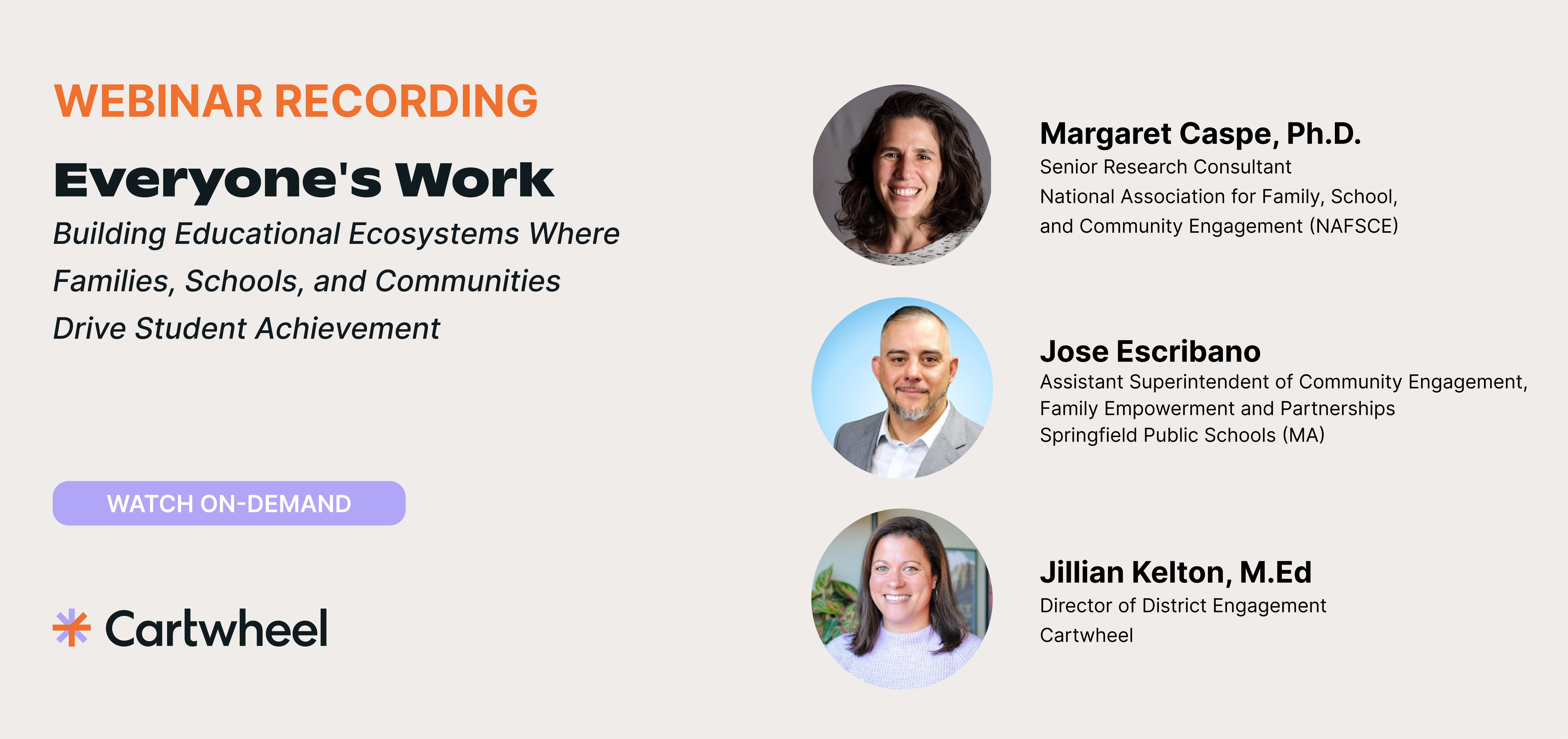
That was the starting point for Cartwheel's March 2026 webinar, "Everyone's Work," which brought together Margaret Caspe, Ph.D., Senior Research Consultant at the National Association for Family, School, and Community Engagement (NAFSCE), and Jose Escribano, Assistant Superintendent of Community Engagement, Family Empowerment and Partnerships at Springfield Public Schools, for a conversation grounded in both research and practice.
What the discussion made clear is that the most effective family engagement is built as infrastructure: a system woven into how districts train staff, design accountability, and build trust with communities.
Family engagement is a system, not a strategy
One of the first things Margaret Caspe established is something that sounds simple but reshapes how leaders should approach this work: family engagement isn't an event. It's a relationship-building process that happens across time, across settings, and involves families, schools, and communities working as genuine partners.
"Family and community engagement is really a process of relationship building," she said. The research her team draws on emphasizes that when engagement is practiced as a shared responsibility — not something schools do to or for families, but together with them — it reliably drives stronger academic outcomes, higher attendance, and better social-emotional outcomes for students. It also raises teacher satisfaction and supports community well-being.
But Margaret was equally direct about the limits of events-only approaches. Back-to-school nights, permission slips, robocalls — districts often run these with real intention and genuine effort. The issue isn't the events themselves; it's that no amount of events can substitute for a system. "We can't just have random acts of family and community engagement sprinkled here and there," she said. "We need a real system of leadership, of funding, of support staff really coming together to build family engagement systems."
Her analogy was pointed. You can source the engine from one high-end car and the brakes from another, but without the parts working in unison, you don't have a car. You have a pile of car parts, not a functioning system. The same is true of family engagement.
The gap isn't effort. It's orientation.
Jose Escribano came to district leadership through an unusual path: social worker, family therapist, and school adjustment counselor before becoming a principal and then a district administrator. That background shaped how he saw the opportunities to strengthen family engagement at Springfield Public Schools, and how he approached building something better.
"At the core was the relational piece," he said of his time leading turnaround schools. "I had to build trust with the parents to allow me to turn those schools around."
At the district level, he draws heavily on family systems theory. The core idea: you can't work with someone in isolation because people are interconnected. Families aren't outside the system. They're part of it. That mindset shift changes everything about how schools approach outreach, discipline, enrollment, and attendance.
"Now they are not our customers," he said. "They are part of the system."
That reorientation drove a series of structural changes at Springfield. When Jose took over family engagement, parent concerns were being routed through multiple entry points: enrollment, the chief schools officers, the superintendent's office. There was no central tracking and frequent follow-through gaps. He consolidated everything into a single Family Community Engagement Office, with a 24-hour response commitment and a clear routing system to involve the right departments. The solution was structural. Families were heard faster, frustration dropped, and the office built the kind of credibility that makes deeper engagement possible.
Changing how staff engage families — especially in schools where distrust has built up over time — doesn't happen in a year, and Jose was clear about that. The structural changes were the relatively easy part. The harder work was shifting the culture that surrounded them.
He applied the same lens to enrollment and attendance. On enrollment, the district's online platform was built during COVID and never updated; it was purely one-directional. During peak season, with thousands of enrollments happening simultaneously, families had no way to check their status or know what was missing. That created confusion and eroded trust before a child even walked through the door. The solution was structural: better technology, two-way communication, and visibility for families throughout the process.
On attendance, Jose moved away from a punitive, linear approach. Instead of a rigid sequence of steps tied to absence counts, his team began meeting with families early in the school year, before absences compounded, with a focus on understanding barriers rather than delivering consequences. "Attendance is very complex," he said. "It's not a one-size-fits-all."
The results are early, but meaningful. Four Springfield schools that fully committed to this relational approach have cut their chronic absenteeism rates in half; from figures around 29–30% down to 15–16%.
What the research says about high-leverage practice
Margaret's team at NAFSCE developed the Family Engagement Core Competencies to help districts identify where to focus. The framework organizes effective practice into four areas: reflect, connect, collaborate, and lead.
Reflect is about educators examining their own assumptions, moving away from deficit thinking about families and toward genuine recognition of the strengths families bring. Connect is the trust-building work: listening, creating two-way communication, and welcoming families as genuine partners rather than audiences. Collaborate means co-creating learning opportunities and making student data accessible and actionable. Lead means giving families real voice in decisions; at the table, not just adjacent to it.
"We can't have collaboration if we don't have communication," Margaret said. "We can't have any communication and collaboration if we don't have that constant ability to examine our mindsets."
The framework doesn't rank these four in order of importance. They have to be braided together. But Margaret noted that one of the most concrete places to start, for districts looking to move the needle on specific outcomes, is creating real two-way exchange: learning from the strategies families already use at home to support their children's learning, and sharing information back in ways that are genuinely useful.
Community is not a referral list
Both Jose and Margaret pushed back on a familiar but limited approach: treating community organizations as referral destinations rather than partners.
Jose described his first year in the chief of family engagement role, when he met with approximately 130 community organizations and individuals. The consistent finding surprised him. They all wanted to help. They just didn't know how to engage the school system. What had existed before was a patchwork; this school had a relationship with this organization, that school with another, with no coherent district-level infrastructure for those partnerships.
His solution was structural: a centralized entry point where organizations could connect, and a matching process that linked partners to the right schools or district-wide initiatives based on what they could offer. What changed wasn't just access. It was accountability. Those relationships became strong enough that Jose could actually follow up when commitments weren't kept.
Margaret described a similar "surround sound" model through NAFSCE's Center for Family Math. The goal is to build learning ecosystems that extend from school into homes, libraries, parks, and neighborhood businesses. It starts with a team that includes parent leaders who know where families actually are on weekends, then expands outward to embed learning in the places families already trust.
"The school is one node in a larger ecosystem," she said. For families who face real logistical barriers or don't yet trust institutions, that community infrastructure is often the way in.
Starting at secondary
The webinar closed with a quick note on secondary schools, where family engagement typically drops off as students move into middle and high school. Jose offered one concrete example from Springfield. A large high school with nearly 2,000 students was navigating the challenge of making personal contact with families when students were absent; the staff-to-family ratio made phone calls impossible at scale. The district implemented text-based outreach as a solution, research-backed and showing early promise for reducing chronic absenteeism.
But he was careful to distinguish between communication and engagement. Texting families about attendance is a communication tool. Real engagement is the longer-term work of building relationships that make those contacts meaningful.
This is everyone's work
Family engagement doesn't belong to one department, one counselor, or one coordinator. It belongs to the entire system, and it has to be resourced, structured, and sustained accordingly.
Whether you're a director of student services thinking about mental health access, a superintendent building a strategic plan, or a school counselor looking to build stronger connections with families, the core question is the same: Is our system designed to include families, or just to inform them?
For most districts, the honest answer lands somewhere in between. And that's not a failure. It's a starting point.
Answering that question honestly is where the work begins.
Interested in how Cartwheel partners with families?
Learn more about how Cartwheel supports families and connect with our team.

.png)