This article is based on a live session presented at the February 2026 Large Unit District Association (LUDA) Conference in Bloomington, IL.
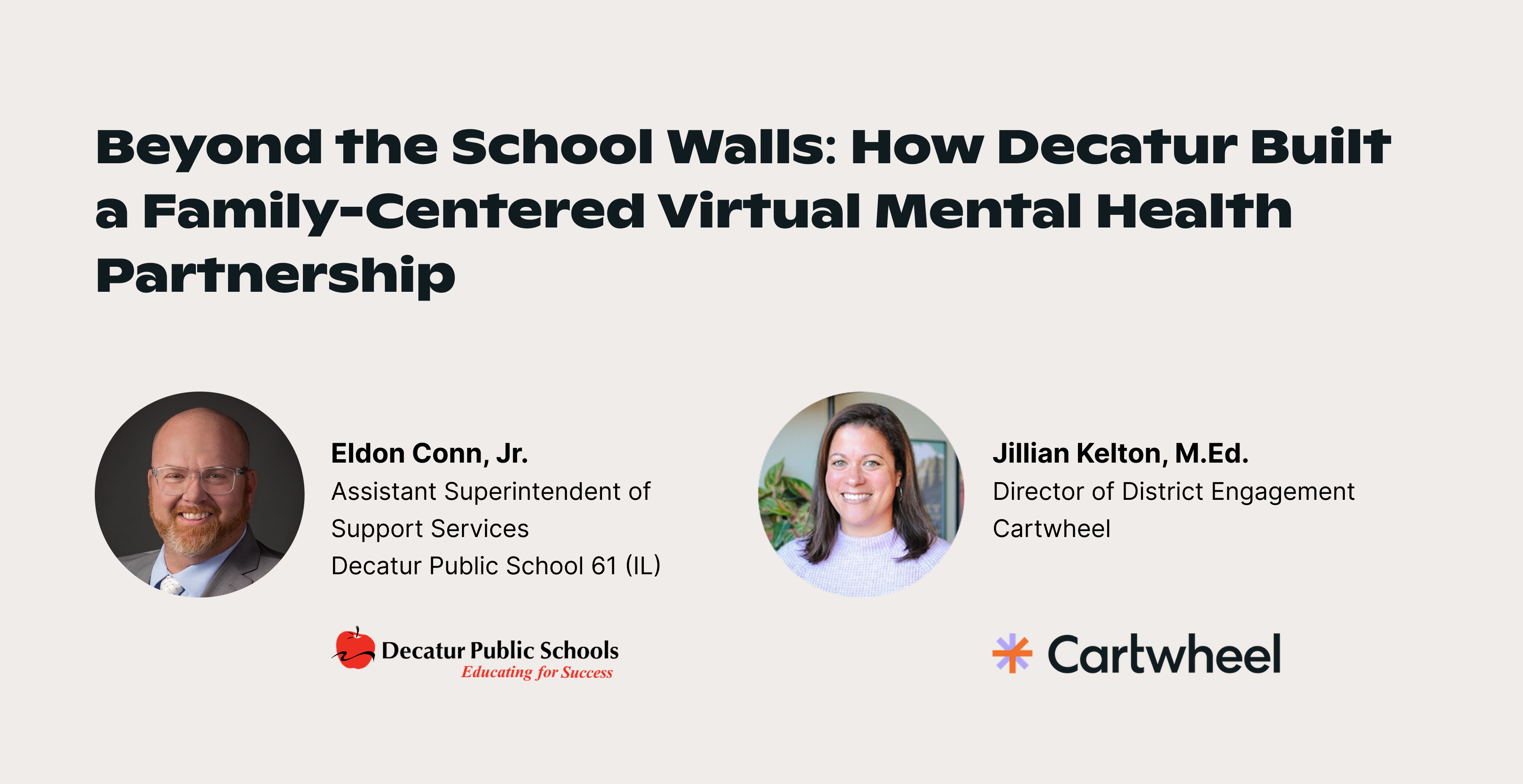
At the 2026 LUDA Conference, Eldon Conn Jr., Assistant Superintendent of Support Services at Decatur Public Schools 61 (IL), and Jillian Kelton, M.Ed., Director of District Engagement at Cartwheel, sat down to share something rare: an honest account of what it actually looks like to build a new mindset around chronic absenteeism — one rooted in community partnership and a fundamentally different approach to engaging families.
Their session — "Beyond the School Walls: How Decatur Built a Family-Centered Virtual Mental Health Partnership" — gave district leaders a concrete, replicable look at what becomes possible when schools treat families as partners in mental health support, not just recipients of outreach.
Chronic absenteeism is a symptom — and the root causes often live outside school walls.
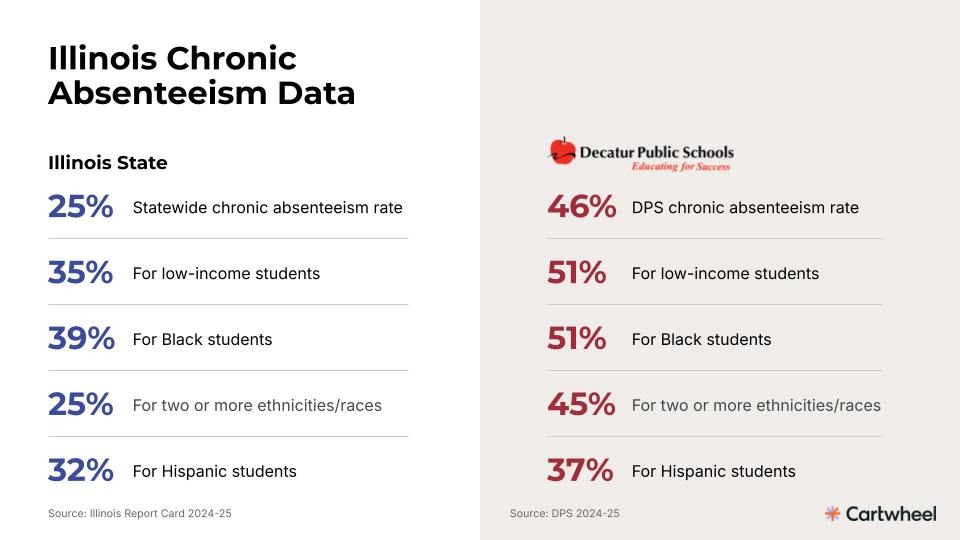
Decatur Public Schools serves approximately 7,700 students across 15 schools. Coming out of the pandemic, the district faced a convergence of challenges: heightened student anxiety, surging mental health needs, a 15% teacher vacancy rate, and a districtwide chronic absenteeism rate of 46% — nearly double Illinois' statewide average of 25%.
"We needed to talk about what was actually keeping kids from coming to school," Eldon said. "Not just write the letters. Not just track the numbers."
What they found wasn't a single cause — and it wasn't a family problem. It was an ecosystem of systemic barriers: housing instability, transportation gaps, post-pandemic disengagement, and a mental health system that required families to wait 3–6 months before a provider returned their call.
When schools treat absenteeism as a student problem, families become bystanders. When they treat it as an ecosystem problem, families become partners.
Rather than targeting students alone, Decatur built a three-pillar model designed to support everyone in the ecosystem simultaneously: students, families, and staff.
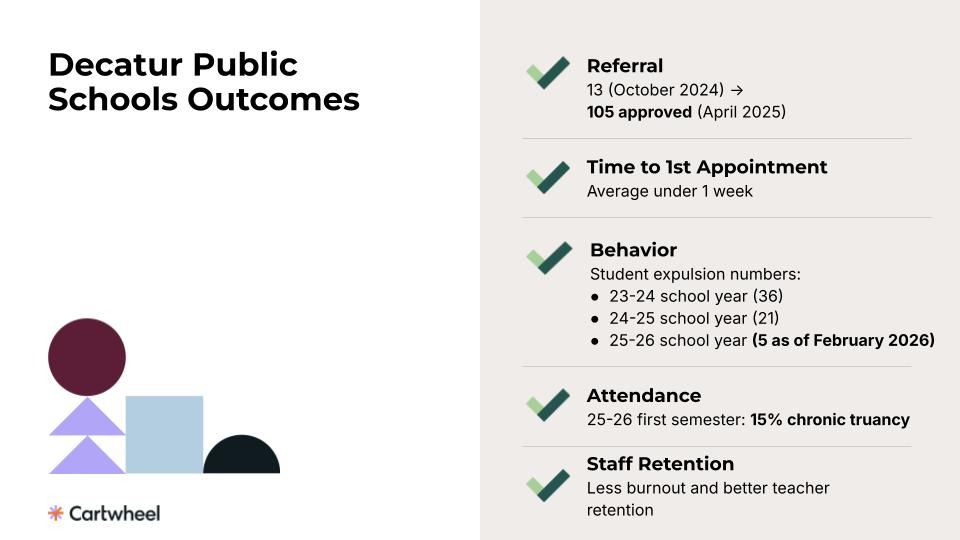
For students, school counselors could submit a referral in under five minutes. Families were contacted within 24 hours. A first appointment with a clinician typically happened within a week — compared to the months-long waits families had come to expect from community providers.
For families, the shift was philosophical before it was tactical — and it started well before Cartwheel entered the picture. Decatur had already been working to move family engagement from transactional to relational: inviting caregivers into MTSS meetings as partners, not just recipients of information, and building district-wide programs to bring families through the door. What Cartwheel added was an accessible, stigma-reducing entry point that fit into that larger strategy. When Communications Director Maria Robertson repositioned Cartwheel as a "family resource" rather than a "school program" — through robocalls, ParentSquare messages, newsletters, social media, and community event outreach — it extended work the district had already committed to.
For staff, the model recognized that burned-out teachers cannot identify struggling students or build the relational trust that brings a kid back to school. Staff wellness wasn't optional — it was structural. Cartwheel services for staff, supplemented by an in-person counseling program through Cole Counseling Services, gave educators a place to go before small stressors snowballed.
The rollout offered hard-won lessons — and what Decatur learned may be the most instructive part.
After the initial launch — board presentations, social media blasts, flyers at every school front desk — Decatur had 13 referrals in the first two months.
"We knew that wasn't enough," Eldon said. "There was a barrier somewhere."
The issue wasn't awareness. It was ownership. Staff understood that counselors, social workers, and administrators were the ones who could formally enter referrals. What no one had communicated clearly enough was that anyone who noticed a concern could bring it directly to those three people.
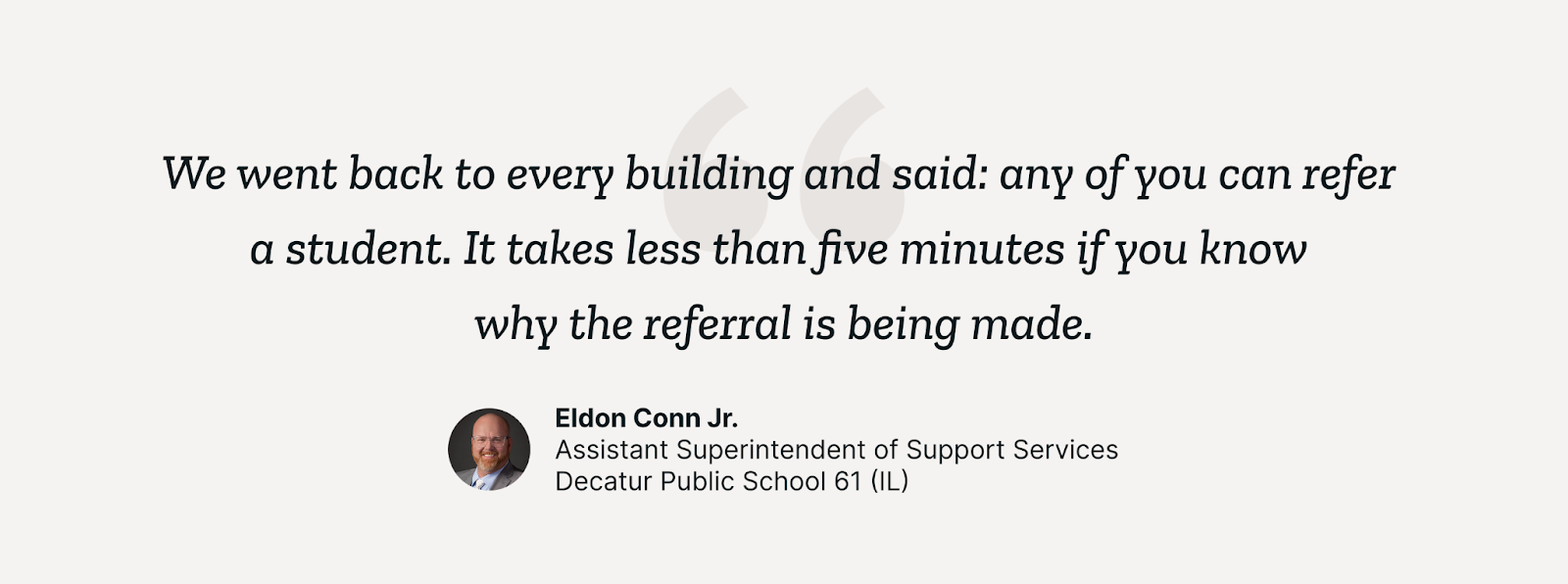
The fix was going back to every school — not just the principal, but the full staff — and reframing the message. Within 45 days of that second wave, referrals jumped to over 100.
One story from the session captures why this matters: a lunchroom employee noticed a student's behavior, attitude, and appearance changing over three to four weeks. She brought her concerns to the school counselor, who submitted a referral. That student is still on an active treatment plan today. It's a reminder that the adults closest to students aren't always the ones with a formal role in student support — and that when everyone feels empowered to notice and act, students can get connected to help sooner.
Virtual services reduced a barrier that Decatur's families had been navigating for years.
One of the most consistent themes in Decatur's experience — and a question many district leaders raise — is why virtual care has resonated with families who hadn't previously connected with community providers.
For Eldon, a significant part of the answer is stigma. Families in Decatur, like families in many communities, worried about being seen walking into a therapist's office. Virtual care removed that barrier. Sessions could happen at home, at school, via phone or video — at a time that worked around family schedules and without requiring transportation.
"Families in a small community know that if they go to the local therapist's office, someone's going to see them," Eldon said. "Virtual care took that off the table entirely."
Cartwheel also assigned dedicated care coordinators whose role was to guide families through the process: answering insurance questions, explaining what services looked like, and giving families full control over what was shared back with the school. That autonomy mattered.
"Families began viewing the school not as an enforcer of attendance," Eldon said, "but as a collaborative ally in their child's well-being."
The outcomes Decatur is seeing connect mental health support directly to attendance, behavior, and school climate.
By April 2025, Decatur had grown from 13 referrals to 105 students in active services. The early outcomes are significant:
- Chronic truancy dropped from 51% to 15% by end of first semester 2024–25
- Chronic absenteeism fell approximately 8.7% over the same period
- Expulsions decreased from 36 in 2023–24, to 21 in 2024–25, to just 5 as of February 2026
- Staff demand for wellness support grew enough that the district expanded its contract with Cole Counseling Services
"When kids are in a better mental state, they come to school," Eldon said. "You can see it. The grades improve. Everything."
Family engagement isn't a soft metric — it may be a leading indicator of whether interventions work at all.
For district leaders rethinking their approach to chronic absenteeism, Decatur's experience surfaces several themes that other districts may recognize.
Chronic absenteeism is an ecosystem issue, not a student behavior problem. When districts expand their lens to include families and staff — not just students — the solutions available to them expand too. "We realized that absenteeism wasn't one thing," Eldon said. "It was part of our ecosystem."
The language you use shapes who engages. Repositioning mental health support as a family resource rather than a school program changed who responded and how quickly. Families who once felt like they were being called in to hear bad news began showing up as partners. "The shift from 'school program' to 'family resource' is more than messaging," Jillian noted. "It's a fundamental reorientation toward families as true partners in this work."
Ownership of the referral process belongs to everyone in the building. Not just the people who enter referrals — but every adult who sees a student every day. When staff at every level feel empowered to notice and act, more students get connected to support sooner.
"Family engagement isn't a soft metric," Jillian said. "It may be a leading indicator of whether or not your interventions are going to work. You can have the strongest clinical services available, but if families don't trust the system, don't understand the offering, or can't access it — those services sit unused."
Frequently Asked Questions
How did Decatur Public Schools reduce chronic absenteeism? Decatur reduced chronic absenteeism by building a three-pillar virtual mental health model that supported students, families, and staff simultaneously. Rather than treating absenteeism as a compliance issue, the district reframed it as an ecosystem problem — and partnered with Cartwheel to expand mental health access without waitlists.
How does virtual therapy support school attendance? Virtual therapy removes logistical barriers like transportation and scheduling that can prevent families from accessing in-person care. It can also reduce stigma, since families can receive support at home or school without visiting a community provider's office. In Decatur, students receiving services showed early improvements in attendance and a reduction in behavioral escalations.
How can school districts fund virtual mental health services sustainably after ESSER? Cartwheel bills family insurance directly — including Medicaid and Medicare — which reduces reliance on district general funds. Decatur's model expanded mental health capacity without hiring full-time staff, making it financially sustainable beyond one-time federal funding.
What strategies help districts engage families who haven't yet connected with services? Decatur's experience points to several factors: meeting families through multiple channels (robocalls, text, social media, community events), reframing services as a family resource rather than a school intervention, and prioritizing trust-building over compliance. When families feel like partners — not just consent-givers — engagement tends to follow.
To learn more about how Cartwheel's virtual mental health services can support your district's approach to chronic absenteeism and family engagement, we'd welcome the opportunity to connect.

Connect With the Speakers
Eldon Conn Jr.
Assistant Superintendent of Support Services, Decatur Public School 61 (IL)
Jillian Kelton, M.Ed.
Director of District Engagement, Cartwheel